Holodomor Genocide Museum, Kyiv
.jpg)
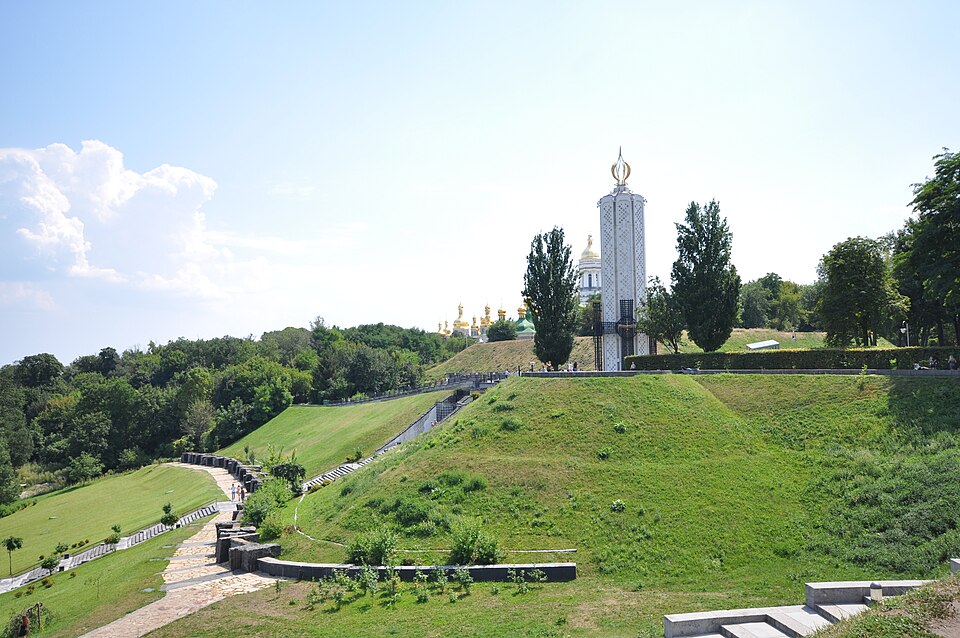
The "Candle of Memory" above the Dnipro — the national memorial to the victims of the Holodomor of 1932–1933.
The Holodomor of 1932–1933 was an artificial famine organised by the Soviet authorities. According to the Ptoukha Institute for Demography and Social Studies of the National Academy of Sciences of Ukraine, losses from excess mortality in 1932–1934 amount to 3.9 million people — 3.6 million in the countryside and 0.3 in the towns — plus 0.6 million unborn; the greatest relative losses were in Kyiv and Kharkiv regions, 19–20 per cent of the population. The Ukrainian diaspora and some historians work with figures of over seven million; the Academy's demographers consider losses above five million impossible. The memorial with the central "Candle of Memory" and the sculpture "Bitter Memory of Childhood" was ceremonially opened on 22 November 2008, the complex designed by Anatolii Haidamaka and Yurii Kovalov; in 2019 the institution became the National Museum of the Holodomor Genocide. The museum's second phase, of 15,000 square metres, has been under construction since 2008.
15-A Ivana Mazepy Street. The Hall of Memory is open Wed–Sun 10:00–18:00, closed Mon–Tue; an adult ticket costs 30 UAH (museum website, 01.10.2026). During an air-raid alert the museum closes; the nearest shelters are the underpass on Slavy Square and Arsenalna metro station (museum website, 01.10.2026); on holidays the hours may change (museum website, 09.04.2026).