Kyiv
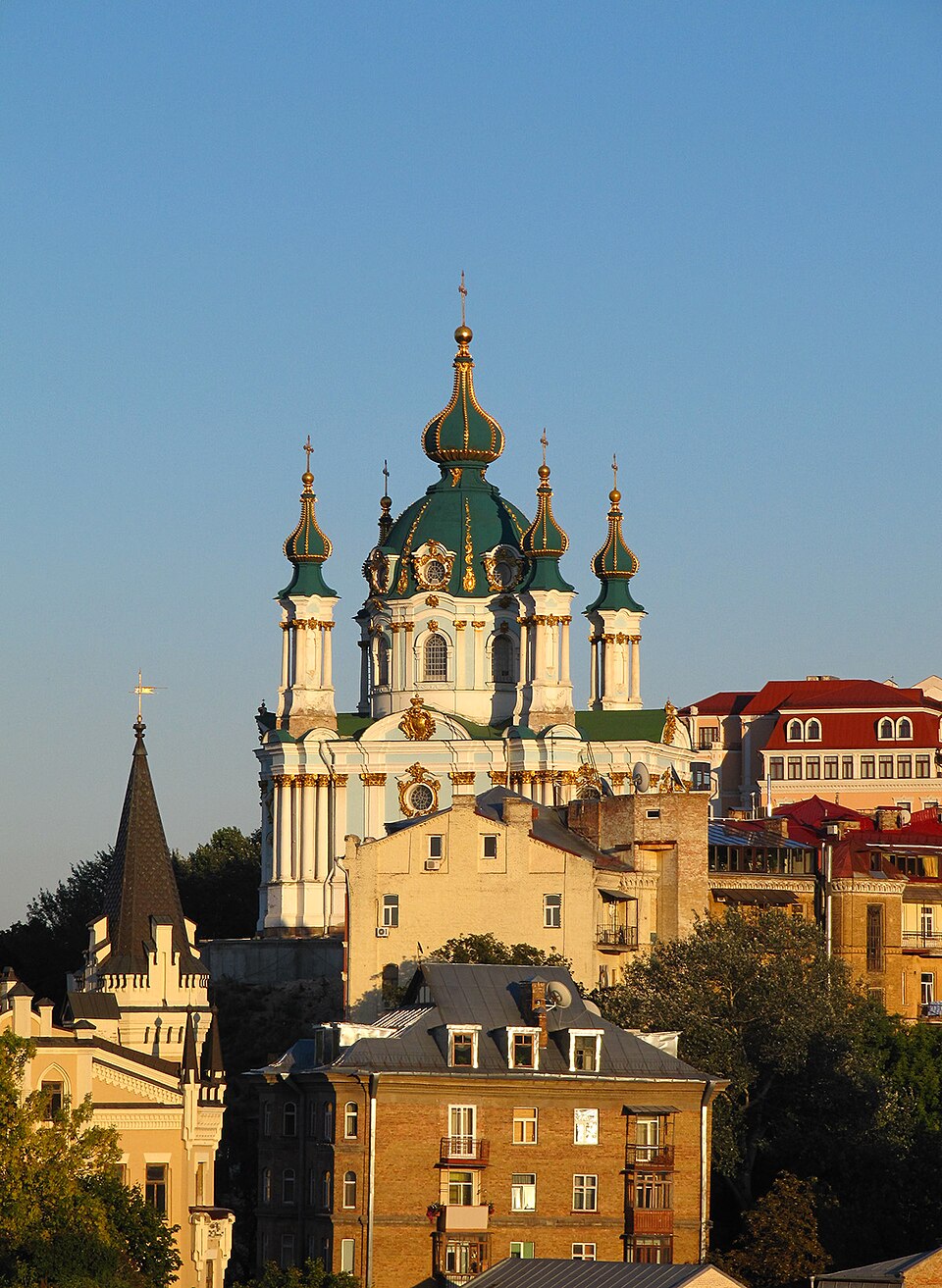

A capital whose age is still disputed: the “1500th anniversary” of 1982 was politics, not a date.
The chronicle traces Kyiv to Kyi, Shchek, Khoryv and their sister Lybid: “they founded a town in the name of their eldest brother”. The year 482, used for the 1500th anniversary celebrated in 1982, has no scholarly basis — the archaeologist Serhii Taranenko calls it politically motivated. Archaeology says something else: the wooden structures of Podil lie eleven to twelve metres deep and are dated by dendrochronology to 887, while the continuous cultural layer begins in the last quarter of the ninth century. The Encyclopedia of Modern Ukraine dates the start of continuous development to the second half of the fifth and the first half of the sixth century. There were settlements on these hills earlier, in the second and third centuries, but they had no connection with one another. Maksym Strikha says of Kyiv what is said of Rome and Jerusalem: it emerged rather than was founded. The Encyclopedia of Modern Ukraine traces princely Kyiv to Oleh the Wise: he reigned here at the end of the ninth and the beginning of the tenth century, and the chronicle dates his arrival to 882. Then Ihor the Old, whose treaty with Byzantium the chronicle dates to 944; Princess Olha, who in 959 sent envoys to the German king Otto I; Sviatoslav the Brave — and Volodymyr the Great (980–1015), under whom Rus was baptised in 988. This point stands on Starokyivska Hill, where the city began: Volodymyr's citadel and the Desiatynna Church (Church of the Tithes), under whose rubble the last defenders died in 1240. St Sophia and the Lavra were inscribed on the UNESCO list in 1990 as a single site, and in 2023 on the list of heritage in danger. At Kyiv University on 25 December 1916 Oleksandr Koshyts’s student choir first sang “Shchedryk” by Mykola Leontovych — six years later Koshyts’s chorus sang it at Carnegie Hall. Kazymyr Malevych was born here (1879); in 1904 Mykola Lysenko opened his music and drama school, Borys Hrinchenko published the four-volume Dictionary of the Ukrainian Language (1907–1909), Les Kurbas founded the Young Theatre in 1916, and in 1928 Valerian Pidmohylny wrote the novel “The City” about this city. On 16 September 2000 the journalist Georgiy Gongadze disappeared in Kyiv.
The point stands on Starokyivska Hill, where the city began. Kyiv regularly comes under missile and drone strikes: on 30.09.2026 3 people were killed, and the Shevchenkivskyi and Podilskyi districts were among those hit (Obozrevatel, 30.09.2026). During an alert go straight to a shelter: the nearest metro station or underground passage.
Chronicle
- 882 — The chronicle’s date: Oleh the Wise comes from the north and takes the seat in Kyiv. The Encyclopedia of Modern Ukraine is more careful — "the end of the 9th to the beginning of the 10th century".
- 887 — The dendrochronological date of the oldest wooden structures of Podil — archaeologists count continuous city life from it.
- 944 — The treaty of Ihor the Old with Byzantium — the chronicle relies on it when retelling the terms of trade and peace.
- 969 — Princess Olha died; her grandson Volodymyr later moved her relics to the Church of the Tithes. The church honours her on 11 July.
- 972 — Sviatoslav the Brave died by the Dnipro rapids, near Khortytsia.
- 988 — The Christianization of Rus under Volodymyr the Great.
- 15 July 1015 — Volodymyr the Great died at the country estate of Berestove; from this date the Institute of National Remembrance counts the Day of Ukrainian Statehood.
- c. 1037 — St Sophia's Cathedral under Yaroslav the Wise; Nadiia Nikitenko dates it to 1011–1018, and it was on that dating that the millennium was marked in 2011.
- 31 May 1223 — The battle of the Kalka: Mstyslav Romanovych of Kyiv was among the six princes who died. The Institute of National Remembrance and Radio Liberty date it to 31 May, Oleksandr Holovko to early June.
- 5–6 December 1240 — The Mongols broke through the wall by the Liadski Gate and burst into the city; Voivode Dmytro was taken prisoner after the Desiatynna Church collapsed.
- c. 1362 — Kyiv passed peacefully to the Grand Duchy of Lithuania.
- 1482 — The army of Khan Mengli Giray I took the city and burned it.
- 1490s — Magdeburg law; Nataliia Bilous dates the charter to about 1498. It was abolished by a decree of Nicholas I in 1834.
- 1615–1701 — The brotherhood school at the Bohoiavlenskyi (Epiphany) Monastery became a collegium and, in 1701, an academy; it was closed in 1817 and restored in 1991.
- 22 January 1918 — The Fourth Universal of the Central Rada: the proclamation of the independence of the UNR (Ukrainian People's Republic).
- 19 September 1941 — German troops entered Kyiv; on 29–30 September came the mass shooting at Babyn Yar.
- 6 November 1943 — Kyiv was completely freed from the Nazis.
- 24 August 1991 — The Verkhovna Rada adopted the Act of Declaration of Independence of Ukraine.
- 21 November 2013 – 22 February 2014 — The Revolution of Dignity: from the halting of the Association Agreement to the flight of Yanukovych; the Heavenly Hundred died on 18–21 February.
- 24 February – 2 April 2022 — The battle for Kyiv; on 2 April the Kyiv region was liberated.